Stacked Rifles Historical Marker, 2006
Lumber and safety orange paint, 5' b x 8' h
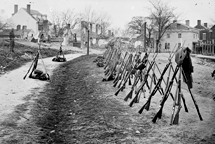 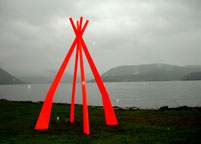 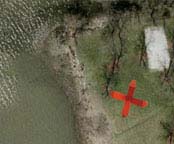
Stacked Rifles Historical Marker references Peekskill’s military and geographical history.
“Peekskill was a significant Revolutionary War military base, and at times used as a headquarters for American army officers in the Hudson Valley from 1776 through 1782. The area was important for its hilly defensive location, its views of the bay, and its industries applied to military purposes. The overlook locale, now identified as "Fort Hill" in Peekskill, was the site of five large barracks buildings and two redoubts. An average of 1,000 Continental soldiers were stationed at Camp Peekskill on and off through the eight years of war”.
The piece takes its abstract form from stacked rifles; this familiar configuration symbolizes soldiers at ease. The piece is painted in safety orange, which is the standard color for defining a protective space, marking a location or the need for awareness. When viewed from directly above, the sculpture’s four abstract rifles create an X, both marking the spot as a place of significance, and calling for future vigilance.
*excerpts from History of Peekskill
Written by John J. Curran, City Historian
January 2002
Blue Collapsible Sculpture, 2006
Polytarp, conduit and fastener, 2' b x 9' h
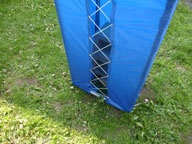 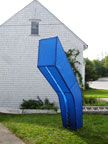 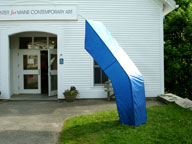
This temporary sculpture is drawn from my time in Maine and my experience of the back roads and front lawns that define its domestic landscape. Blue poly tarps that are commonly used across the state to cover and protect materials and possessions from the weather are also employed around the country and in many parts of the world, revealing this simple and inexpensive commodity as a universal, versatile, and practical answer to a wide range of situations. The same standardized sheets of plastic that extend protection and ownership beyond the enclosure of the home also extend the territory of humanity and inhabitability when configured as a provisional humanitarian aid in the exigency of natural or manmade disaster.
This piece explores the blue tarp’s universal connotation of temporality and protection to extend interior, architectural space into the exterior landscape, while its removal from banal yard service or terrifying disaster footage attempts to focus attention on its function and dysfunction in the contemporary culture of impermanence and instability.
Gettysburg Address, 2006-ongoing
Ink on caution tape, 3 " x 300' each roll
St. Louis and Los Angeles sites are installed by: Maria Santos and Jim Delaney
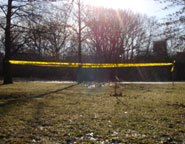 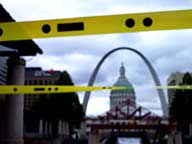 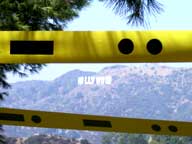
This ongoing project commemorates President Abraham Lincoln's Gettysburg
Address as a dual-purpose text. Not only did this short speech serve
to consecrate a battlefield as the "final resting place for those
who died," but it also reminded the nation of the "great task
remaining." By repairing the political, geographical, and moral
division, Lincoln asserted, "the dead shall not have died in vain".
This piece translates the famous opening lines from this speech into
American Morse code, signifying a telegraphic communication echoing
from the past. The series of dots and dashes is painted on yellow caution
tape, which cordons off a space, consecrating it and delineating it
from the ordinary perimeters of life. (more to come)
Jersey Barrier Bench Attachment, in progress
Concept model of street furniture
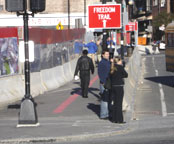 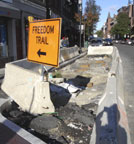 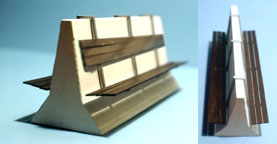
Jersey barriers are used on
construction sites, to block off restricted areas, and more recently,
to create a safe distance between surface streets and vehicles and sensitive
sites and monuments. The barriers which restrict vehicle intrusion also
render these important civic places unattractive and unfriendly for
pedestrians. As what started as a temporary safety measure becomes increasingly
more permanent, widespread, and unavoidable, a new way to reinterpret
these barriers for the benefit of the pedestrian population has become
critical. (more
info)
Extension,
Landscape installation (concept proposal)
with Marrikka Trotter
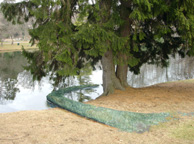 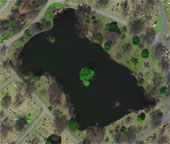 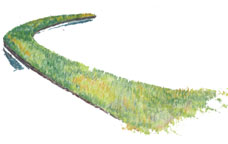
To dwell is to extend: to inhabit a desire or memory, project it in
space, and inscribe it in a landscape. The seminal writing on dwelling,
Heidegger's "Building, Dwelling, Thinking," explores dwelling
as an extension of a person's very being, either through building edifices
or through cultivation of the land. Although the noun, dwelling, has
become linked with a structural building, the verb is intertwined with
people's habit of extending their own mortality by establishing, cultivating,
and preserving a landscape or place. In short, to dwell, the verb, is
about extending a personal experience not only through space, but also
in time and memory.
The Alamo, 2003
Video projection, loop
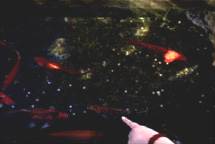 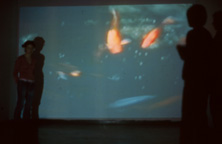
This project seeks to explore the significance of a place as a reliquary
for an epic of courage. The Alamo has been largely reconstructed from
the ruins of a historic Spanish mission to become a park-like tourist
attraction. The meticulously manicured landscape which now surrounds
the infamous site of death and defeat for such historical figures as
Davey Crocket and James Bowie is accented with an artificial stream
stocked with colorful koi and innumerable pennies. The stream, with
its clear water and brilliant orange fish, provides an accessible distraction
and an anticlimax to the stern and silent chapel, with its roped-off
displays memorializing the fallen heroes of Texas. The disneyfication
of historical sites commodifies and reduces significant historical sites
to places of entertainment and activity. The piece is to be projected
at a large scale, as if to endow the graceful movements of the fish
with deep meaning.
|